
Website of the month: Self-timer online
Anyone who collects cameras knows the space problem: a single shelf is rarely enough, and at some point entire rooms or even flats are occupied. Those who have dedicated themselves to external self-timer cameras, on the other hand, can house an impressive collection in a jewellery box - and still collect an amazing piece of photographic history. This is exactly what Andreas Sieg demonstrates on autoknips.jimdofree.com with impressive consistency.
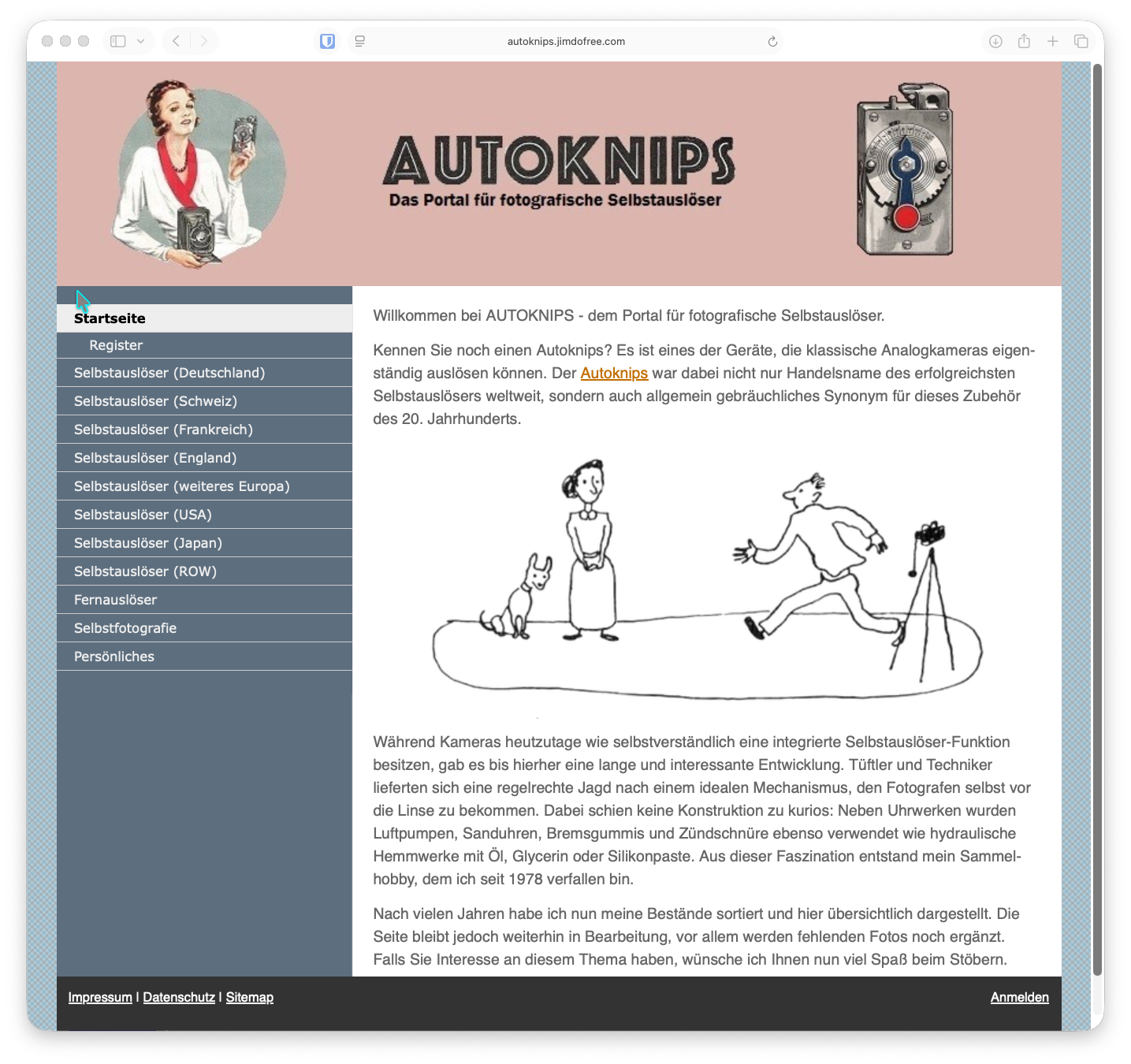
Behind the modest-looking Jimdo address is a private research project of considerable scope: around 1,200 devices in the collection, kilos of original documents and the recognisable ambition to do justice to every single item as far as possible. Anyone who takes the trouble to click through the alphabetical index will quickly realise how large this seemingly niche area actually is: the first few letters alone list brands such as Accura, ADA, Adina, Admiral, Agfa, Alibert, Amica, Arco, AS, Auto-Bob, Autoclick, Autoknips, Autopoze, Balda, Bellmann, Boumsell, Braun, Burke & James, Canon - and so it goes on rapidly to the end of the alphabet.
The diversity of mechanics
What makes the book particularly entertaining to read is the almost absurd range of solutions that inventors and technicians have used over the decades to tackle what is actually a simple problem - "a delay, then a press of the shutter release". In addition to the classic clockwork, there are air pumps, hourglasses, brake rubbers and even fuses as well as hydraulic escapements with oil, glycerine or silicone paste. Sieg categorises these constructions not only in terms of collecting, but also in terms of patent history - every patent mentioned can be traced via Espacenet, inventor biographies are researched and placed in the context of the respective time.
The Autoknips itself
The portal is named after the Hamburg-based Autoknips, whose brand name became so successful that it became a general synonym for the entire appliance class. Models I, II and III each have their own detailed pages with variants, labelling, packaging and dating information. Anyone who has ever tried to categorise an Autoknips more precisely will appreciate the year code engraved on the side - a little dating aid that is neatly documented and explained here. There are also chapters on the German competitors (Balda, Contessa-Nettel, Ernemann, Drexler, Hama, Leica, Morat, Weber, Zeiss Ikon) and systematic country overviews - Switzerland, France, England, other European countries, USA, Japan and "Rest of World".
History between the lines
Particularly nice: the historical context is not neglected. For example, the reader learns how the Autoknips factory had to cease domestic deliveries in 1941 - documented by a postcard from 28 July 1941, which is reproduced in the original and contains a friendly rejection from a customer. In 1943, the factory was destroyed in the bombing raids of "Operation Gomorrah". After the war, Friedo Klapprott initially rebuilt it together with his uncle Friedo Wiesenhavern's photography business. With the economic miracle came the Autoknips IV, a design by Klapprott & Lampe, which could be screwed directly onto the Compur thread and was registered as a utility model (DBGM 1660331) in 1953.
Or the other side of the Atlantic: Robert Faries (1837-1919) in Illinois, actually a bicycle dealer, transferred the pneumatic principle of his bicycle air pump into a self-timer in 1900 - the Autopoze. Its advertising charmingly promised: "Be your own life in the landscape, horseman, bicycler, fisherman, hunter, shepherd, or what not. Take an Autopoze with you on your outing and bring back evidence that you were there." And in "My Top 10" you will find even more bizarre designs such as the I'M-IN-IT from 1913, in which a metal block slowly slides down a rack to finally tip over the release lever.
Conclusion
If you find an inconspicuous self-timer in your accessories box and don't know what's actually in front of you, you'll probably find an answer here - or at least an excellent starting point for further research. Andreas Sieg cultivates a form of collector's virtue that the Internet could do with more of: thorough, well organised, with a love of sources and without vanity. And perhaps this is the beginning of a new, space-saving passion for collecting.