
Efka and Futura - on the categorisation of a fundamental work
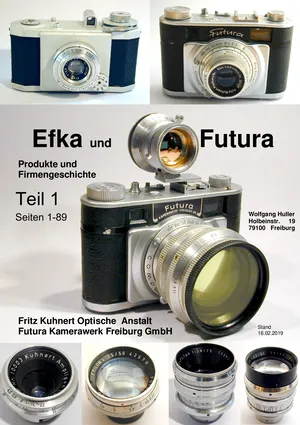
With the inclusion of the documentation "Efka and Futura - Products and Company History" by Wolfgang Huller in the Edition Club Daguerre, a self-contained, systematic presentation of the history and product range of Fritz Kuhnert Optische Anstalt and Futura Kamerawerk Freiburg is available for the first time.
As far as the Club is aware, no other work currently exists that combines a comparable scope, level of detail and documentary accuracy. The decisive factor here is not so much the volume of over 200 pages, but rather the methodological approach on which this work is based.
Huller does not limit himself to describing individual camera models, but establishes connections. Cameras, lenses and accessories are viewed as interrelated components of a system. Particularly noteworthy is the assignment of known serial numbers to specific equipment features, production variants and accessory configurations. For the first time, this provides a reliable basis for categorising individual devices in terms of time and technology. Many hitherto only presumed connections are comprehensibly documented and differences between variants clearly identified.
Another focus is on the systematic analysis of contemporary brochures, price lists and instruction manuals. These sources are not used for illustrative purposes, but are taken seriously as primary material and consistently analysed. Numerous illustrations and documents have not previously been available in this form or have been difficult to access.
The journey of this work to the Club Daguerre is itself part of its history. The contact with Wolfgang Huller came about through Dr Stephan Baedeker, former chairman of the Club Daguerre and a long-time expert on the subject. During a personal visit, Baedeker was given an insight into Huller's collection and documentation and was quick to point out their extraordinary character. His assessment was clear: he had never before encountered such a complete and in-depth reappraisal of Futura in this form. It was through his mediation that contact was established, which ultimately led to the inclusion of the work in the edition.
The fact that Huller was prepared to make this work, which had grown over the years, available to the Club Daguerre is by no means a matter of course. Originally conceived for use on CD-ROM and intended for a small circle of interested parties, the documentation could easily have remained in a closed format. Instead, it was deliberately opened up for permanent storage and accessibility.
The publication in the Edition Club Daguerre gives the work an appropriate and sustainable long-term framework. The edition was created to make available and preserve specialist literature that is out of print or no longer commercially available with the authorisation of the authors. The technical realisation serves exclusively to improve usability. A modern reading interface and a full-text search make it possible not only to read a work such as Efka and Futura, but also to consult it in a targeted manner. Serial numbers, lens designations or accessory information can be found and checked in the relevant context. The content itself remains unchanged; its usability is extended.
In addition to Efka and Futura, a second work, "Vredeborch" by Harald Goergens, has already been published by Edition Club Daguerre. This book also represents a self-contained documentation based on many years of work. Further titles are in preparation and will gradually expand the edition.
In the case of Efka and Futura, a special aspect is added. The documentation is not designed as a preliminary survey, but as a deliberately completed work. Huller has covered the subject in such depth and completeness that it is clear that nothing should be left open here. The fact that he has now turned his attention to other topics is less a farewell than an expression of consistency. A subject area has been penetrated, documented and completed.
It is precisely this closure that gives the work its particular stability. It is not dependent on continuation, but stands as an independent reference.
The Edition Club Daguerre can be reached at
https://edition.club-daguerre.de/
The inclusion of Efka and Futura makes it clear what Edition Club Daguerre stands for. It does not see itself as a platform for quick publications, but as a place where fundamental works are secured and made accessible. Works that are not for a quick read, but for reliable categorisation.